

This video features a Jillian Michaels debate between a well-known fitness expert and 20 advocates of the body positivity movement. The discussion explores whether body positivity has normalized unhealthy lifestyles or if it serves as a necessary pushback against fat-phobia and unrealistic beauty standards.
See Alarming Obesity Stats: Rates Tripling in the US
Jillian Michaels vs. Body Positivity Advocates: Inside the Explosive Debate
Obesity and Health
Jillian Michaels argues that obesity is not healthy and that ignoring the risks associated with it can be dangerous, while others advocate for weight-neutral health approaches and emphasize that self-love is a prerequisite for long-term well-being (1:13 – 21:56).
Corporate Influence
The group debates the role of large food companies in the body positivity movement. Michaels claims these companies co-opt the movement’s messaging to remove barriers to sales, while activists argue that the movement itself is about systemic justice and equality (21:56 – 45:00).
Trauma and Disordered Eating
The conversation covers the complexities of trauma and how it impacts eating behaviors. Participants challenge Michaels on her approach to fitness, particularly regarding her time on The Biggest Loser, and discuss how to support people without relying on toxic shame (45:00 – 1:28:02).
Shame vs. Empowerment
The final segment focuses on whether shame is a useful motivator or a harmful tool. Jillian Michaels maintains that acknowledging personal health markers is doable, while the activists emphasize that true liberation comes from rejecting the shame associated with body size (1:28:02 – 1:46:02).
The debate featured several highly contentious exchanges between Jillian Michaels and the body positivity activists.

The most intense arguments in this Jillian Michaels debated focused on these areas:
The Medicalization of Weight and Obesity (1:13 – 21:56):
The opening segment was particularly heated as Michaels asserted that excess body fat is inherently unhealthy and that “healthy at any size” is a dangerous myth.
Activists pushed back, arguing that this framing is stigmatizing and harmful, leading to a tense exchange over whether weight-neutral care or weight-loss interventions are more beneficial for long-term health.
The Role of Big Food and Corporate Co-opting (21:56 – 45:00):
Michaels argued that large food companies (like Coca-Cola and PepsiCo) profit significantly by co-opting body positivity rhetoric to remove “health concerns” as a barrier to sales.
Activists strongly disagreed, maintaining that the movement is fundamentally about systemic justice, human rights, and rejecting diet culture, not a marketing tool for corporations.
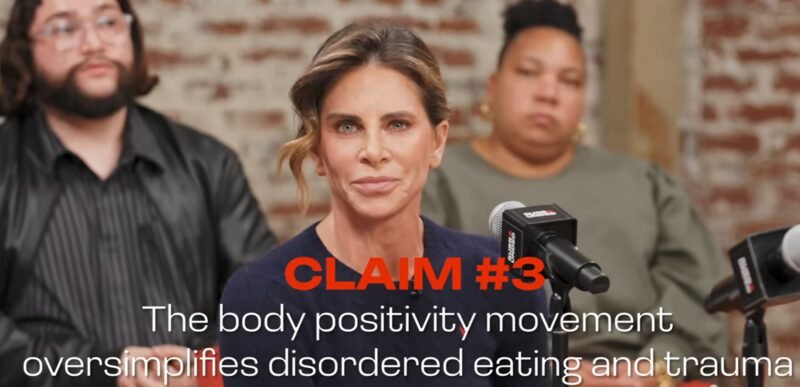
Trauma and Motivational Tactics (45:00 – 1:28:02):
Participants challenged Michaels on the ethics of her methods on The Biggest Loser.
The argument became personal and intense when discussing how trauma influences eating disorders.
Activists criticized the use of intense, shame-based motivation, while Michaels defended her methods as urgent, life-saving interventions for individuals facing immediate medical crises (the “ticking clock”).
Shame as a Tool vs. Empowerment (1:28:02 – 1:46:02):
The final debate centered on whether shame serves as a necessary wake-up call for change or an inherently damaging emotion.
Michaels argued that shame can be a helpful signal for self-reflection, while the activists maintained that liberation is only possible once an individual completely detaches their self-worth from societal body standards and rejects the internal and external imposition of shame.
It’s a Ticking Clock: The Biggest Loser
She uses this metaphor to describe the high-stakes, urgent nature of the health interventions she performed with contestants who were facing life-threatening medical conditions. Specifically, she discusses a situation with a contestant whose severe health markers—including type 2 diabetes, early stages of chronic kidney disease, and arterial plaque—meant that without immediate, significant changes, the contestant was at serious risk of not living past the age of 40 (1:06:18 – 1:06:33).
For Jillian, this “ticking clock” justified her using intense, sometimes controversial, motivational tactics to help contestants break through psychological barriers and take action on their health before it was too late (1:07:47 – 1:07:51).
What is the Origin of Body Positivity?
The body positivity movement has its roots in the fat activism and fat rights movements that emerged in the United States in the 1960s. During this period, which coincided with the rise of the women’s liberation and civil rights movements, the initiative was primarily led by Black, queer women who sought to challenge systemic fat-shaming and demand social and political visibility for marginalized bodies.
How did body positivity get started?
The movement began as a form of fat liberation, intended to create space for bodies that were rarely valued or visible in mainstream society.
- Early Advocacy: While some narratives highlight individuals like engineer Bill Fabrey (who began advocacy after seeing the discrimination his wife faced), the movement is widely recognized as having been built upon the foundational work and leadership of Black and queer activists.
- Evolution into the 1990s: Over the following decades, the movement evolved. In 1996, the term was further popularized by authors like Connie Sobczak.
- The 2000s: By the early 2000s, the movement moved into the digital space, where it expanded its scope to advocate for a positive view of all bodies, regardless of size, shape, skin tone, gender, or physical ability.







Leave a Reply